
Introduction: KNS examen | Inburgering KNS
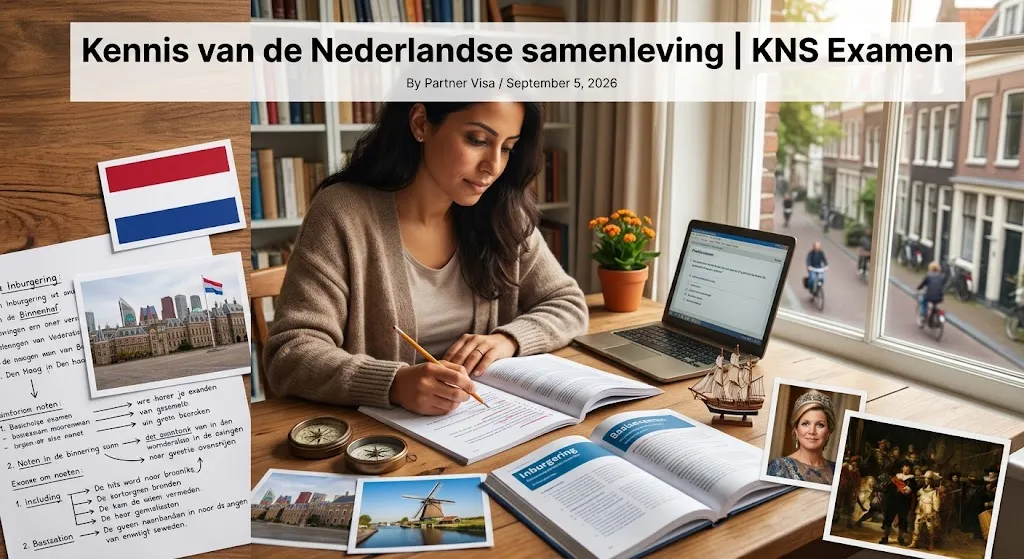
If you are studying for the Basisexamen Inburgering Buitenland (the basic civic integration exam aboard exam), you will be tested on simple facts about Dutch geography, history, government, society, health care, education, and work. None of these facts are difficult once explained clearly. Below, each topic starts with a short introduction, followed by the key facts you need to know.
This guide covers answers to all the 100 questions of KNS (100 vragen KNS). If you understand and remember, all the answers you can easily pass the KNS examen.
Symbols and Royalty
Before anything else, the exam checks whether you recognize a few basic Dutch symbols and historical figures.
- The Dutch flag has three colors: red, white, and blue
- An old portrait shown in the exam is often Willem van Oranje, the historical “Father of the Fatherland” who founded the Dutch royal family line.
Geography: Where the Netherlands Sits
The Netherlands is a small country in Western Europe, bordered by two neighbors and shaped heavily by its low-lying land.
- The Netherlands is located in Europe.
- To the south lies Belgium.
- To the east lies Germany.
- Morocco is larger than the Netherlands.
- The Netherlands is smaller than a country like Turkey.
- The name “Netherlands” means “low land” — a fitting name, since much of the country sits below sea level.
- A dike is a wall built to hold back the sea and rivers.
- Without dikes, the Netherlands would end up under water.
Get a free advice
Cities and Population
Dutch cities each play a distinct role — one holds the government, another the crown, another the busiest port — and the country is densely populated for its size.
- Utrecht is one of the cities that make up the busy Randstad region.
- The country has many people living in it — one of the more densely populated in Europe.
- Amsterdam is the capital city.
- Den Haag (The Hague) is where the government actually works from.
- The King lives in the province of Zuid-Holland.
- Rotterdam is home to the largest seaport in the country.
- Schiphol is the national airport, located near Amsterdam.
Arriving and Settling In
Moving to the Netherlands comes with a few practical realities newcomers should expect from day one.
- Usually your partner helps you settle in when you first arrive.
- You must get a new driving license — you cannot simply keep using your old one.
- The Dutch climate is mostly wet, not dry.
- Roads tend to be busy rather than quiet.
- The country has many bicycles, and cycling is the most typically Dutch way to travel.
- Dutch people generally spend more time indoors than outdoors.
A Short Look at Dutch History
Dutch history spans a long fight for independence, a golden age of trade and art, and a difficult period of war and occupation.
- The King of Spain, who was Catholic, once ruled over the Netherlands.
- The Dutch fought for independence in the Eighty Years’ War, which lasted about 80 years.
- The Dutch state as it exists today has been around for roughly 400 years.
- The famous VOC ships were built for trade, not for fishing.
- The painter Rembrandt van Rijn is one of the most famous artists from the Dutch Golden Age.
- During the Second World War, the Netherlands was occupied by Germany.
- In 1940, the city of Rotterdam was heavily bombed.
- Anne Frank became world-famous because she wrote a diary while hiding during the war.
- Indonesia, a former Dutch colony, became independent after the war.
- Many guest workers came to the Netherlands from Turkey to help with labor shortages.
- Suriname, another former colony, became independent in 1975.
Get a free advice
The Royal Family Today
The current royal family is a common topic on the exam, especially names and backgrounds.
- Today’s royal couple is King Willem-Alexander and Queen Máxima.
- Queen Máxima originally comes from Argentina.
- Their daughter, the crown princess, is named Amalia.
Government and Democracy
The Netherlands runs as a parliamentary democracy, with clear roles split between the king, the prime minister, and elected representatives.
- The Netherlands is a democratic country.
- The parliament is located in Den Haag.
- The most important law in the country is the grondwet, or constitution.
- The minister-president (prime minister) leads the council of ministers — not the king.
- Elected representatives meet in the Tweede Kamer (House of Representatives).
- Elections are held every four years.
- Citizens must be at least 18 years old to vote.
- The Netherlands has many political parties, not just one.
- A mayor (burgemeester) leads a town or city, separate from the national minister-president.
Rights, Freedom, and Equality
Equality, personal freedom, and non-discrimination are core values tested throughout the exam.
- Discrimination is not allowed.
- Women have the same rights as men.
- Women are free to choose for themselves who they want to marry.
- Discriminating against people because they are gay is against the law.
- There is no official state religion — people follow many different religions.
- Newspapers, radio, and television are free to share their own opinions.
- The country has many television channels, not one state channel.
- Owning a weapon without a permit is punishable by law.
- Female genital cutting is punishable by law.
- Hitting or hurting women is punishable by law.
- Being gay is simply allowed, not punished.
Get a free advice
Language and Learning Dutch
Learning Dutch quickly is treated as a priority for newcomers, and it usually comes at your own expense.
- The official language is Dutch, not German.
- It is considered very important to learn Dutch quickly after arriving.
- In language classes, you specifically learn the Dutch language.
- Language courses are usually not free — you pay for the course yourself.
- Watching Dutch television together with children is a good way to help with learning the language.
Family and Daily Social Life
Everyday social habits in the Netherlands follow some patterns that may differ from other cultures.
- Birthdays are celebrated in Dutch culture.
- When visiting someone’s home, people usually make an appointment first, rather than showing up unannounced.
- Grandparents typically live separately from their adult children.
Children and Education
The Dutch school system has its own age milestones, structure, and philosophy around learning through play.
- Parents, not the school, are considered responsible for what their children do.
- Most children start school around four years old.
- Schooling only becomes compulsory starting at age five.
- Education remains compulsory until the age of eighteen.
- Children do learn while they play.
- Parents, not the local government, choose which school their child attends.
- Schools do not have separate classes for boys and girls.
- Children do not wear a school uniform.
- Children using a computer can both play and learn at the same time.
- Voortgezet onderwijs (secondary education) starts around age twelve.
- After age twelve, there are two different educational directions to choose from.
- Full-time schooling continues until age eighteen — roughly the same age young people are allowed to make more of their own choices.
Get a free advice
Health Care
The Dutch health system is built around mandatory insurance and a clear first point of contact for most health issues.
- Everyone is required to have health insurance.
- When sick, the best first step is usually to visit your huisarts (family doctor), not the hospital.
- Prescription medicines are picked up at the pharmacy (apotheek).
- In a real emergency, go straight to the hospital.
- Most medical specialists work inside hospitals.
- The consultatiebureau (child health clinic) is meant for young children.
Work and Employment
Finding work in the Netherlands follows its own norms, from job-hunting methods to interview etiquette.
- In the Netherlands, both men and women work.
- If you are able to work, you are expected to start looking for a job as soon as possible.
- Jobs in traditional industry have become harder to find over time.
- There is a growing need for workers in health care (de zorg).
- It tends to be easier to find work in security roles compared to farming.
- Many people find it easier to get a job through family and personal connections.
- You can register with an uitzendbureau (employment/staffing agency) when looking for work.
- During a job interview, Dutch custom is to shake hands first.
Money and Cost of Living
Newcomers should also set realistic expectations about the cost of everyday life.
- Daily life in the Netherlands tends to be relatively expensive rather than cheap, so newcomers should plan their budget with this in mind.
Final Thoughts
From flags and dikes to elections, schools, and hospitals, these 100 questions cover the basic knowledge every newcomer is expected to know before settling in the Netherlands. Learning these facts is not just about passing an exam — it is also a helpful first step toward understanding how Dutch society works and what to expect from daily life there.